This tutorial is an interactive version of the BLAST chapter of the open-access textbook A Primer for Computational Biology, by Shawn T. O’Neil. The book is licensed under a Creative Commons license.
BLAST, or Basic Local Alignment Search Tool, is a nearly ubiquitous tool for sequence alignment.
Given one or more query sequences (usually in FASTA format), BLAST looks for matching sequence regions between them and a subject set:
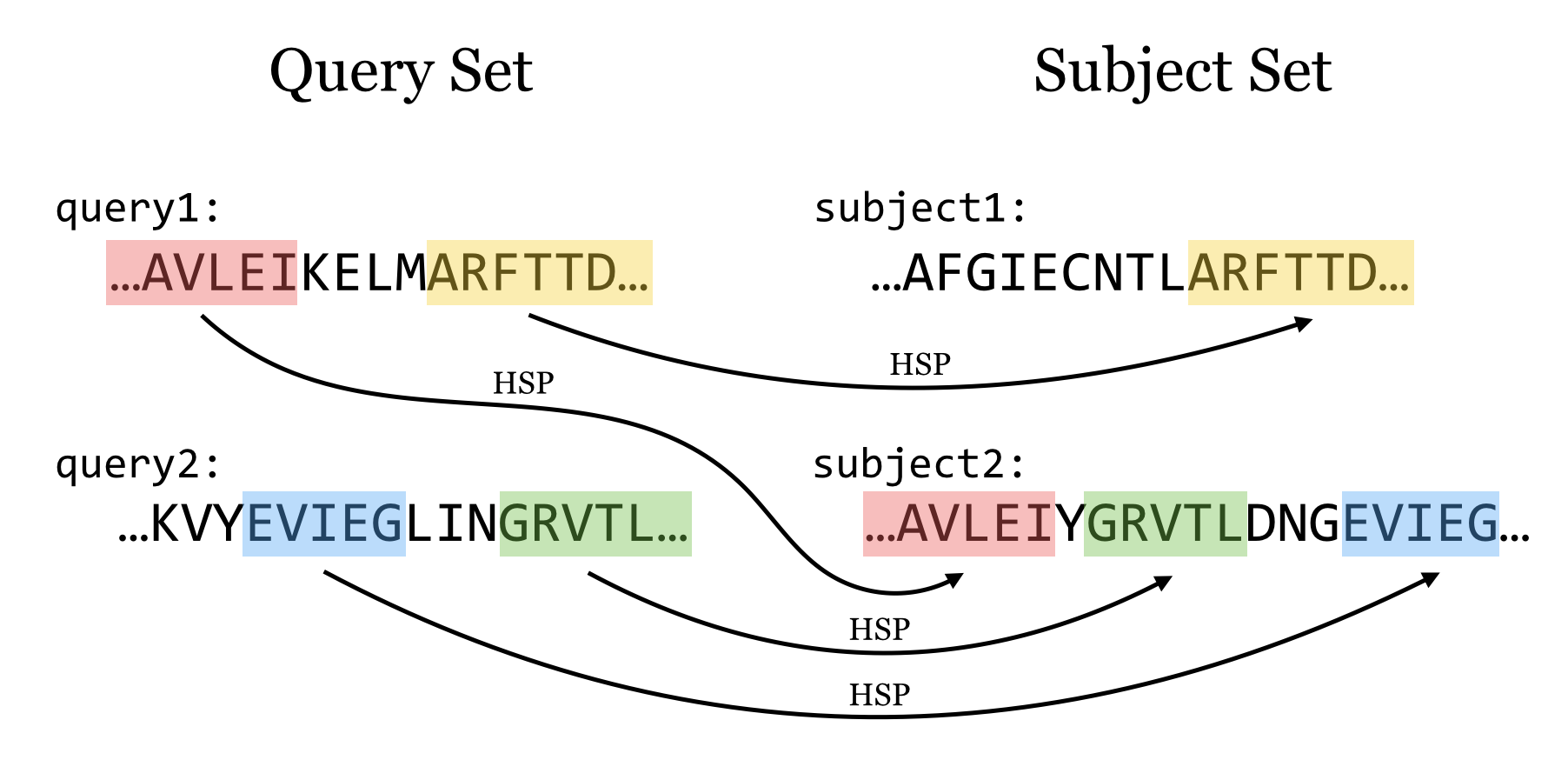
A sufficiently close match between subsequences (denoted by arrows in the figure above, though matches are usually longer than illustrated here) is called a high-scoring pair (HSP), while a query sequence is said to hit a target sequence if they share one or more HSPs. Sometimes, however, the term “hit” is used loosely, without differentiating between the two.
Each HSP is associated with a bitscore that is based on the similarity of the subsequences as determined by a particular set of rules. Because in larger subject sets some good matches are likely to be found by chance, each HSP is also associated with an E value, representing the expected number of matches one might find by chance in a subject set of that size with that score or better. For example, an E value of 0.05 means that we can expect a match by chance in 1 in 20 similar searches, whereas an E value of 2.0 means we can expect 2 matches by chance for each similar search.